Hi, wanna buy a smart city?

Back from Barcelona Smart Cities Expo & World Congress, I’m thinking about what makes cities smart. The sales pitches of companies operating in the field seem to fall into roughly two categories; you can either attach a sensor to everything and thus monitor it all, or then you can install an operating system to the city and then monitor it all.

Preferably, you do the monitoring of the city from an underground Control Centre.

I do have issues with this thinking, especially in the the context of the cities of the developing countries. They are being sold the same gadgets as to the western cities, packed together with to proprietary business models and long-term service contracts.

But what is the most valuable ingredient of a city? it’s people. Cities consist of people. Either they behave smart, or they don’t. Either they participate in making the city better, or they don’t.  Citizens are an untapped resource for the cities. If the cities really want to become smart, they must activate them to work with the city administration in service provision. Smart cities need smart citizens.

Proprietary, vertical silos and City Control Centres are a poor match with the citizen-driven distributed city. Mayors, please, take note: cities are too complex to be solved. Respect the complexity and don’t underestimate the city. If we want to “solve” the city, we need much more resources than just the taxpayers´ money. We need the taxpayers themselves.

The World Bank seems to get this better than most smart city service providers. The World Bank Institute supports collaborative models, empowering the people to harvest data, by opening service interfaces and processes. The CitiSense event brought together global cities, developers and open data advocates to discuss and learn. Let’s hope they can make an impact within the bank as well, as funds should not be wasted in closed systems – especially not in the developing countries.

Image

Clora of @LabPLC speaking about making a difference in Mexico City. Pic by Pablo Collada.

The Janus Face of the Internet

Image

Many people think about the Internet as a tool of empowerment, giving Mr. Everyman possibilities for expression, business success, participation, and so on.

In some aspects I do agree with this romantic vision. Yes,  anyone can start a business there, anyone can have a say. The power of sharing has made history in cases like Wikileaks, and the power of communities can do things which are otherwise utterly impossible, like Wikipedia. But the Internet is a two-faced beast. When something really takes off in the Internet, the businesses centralise and concentrate faster than any business in the history of capitalism.

Look at the numbers: Facebook has a 57% market amongst social media platforms. Google’s share of the search market is 67% (and online-marketing 33%). Global Internet retail grows about 15% annually, and Amazon owns a quarter of it. 200 billion dollars worth of stuff is traded every year on eBay, and collectibles business has moved there, abandoning physical stores. Radical openness as a business model has created the fastest monopolization. Google launched Android late 2007. In four years it became the dominant mobile operating system. The Android landslide combined with the disruptive Apple ecosystem pushed the former leader Nokia out of the market.

Many of these companies have built their empires in just a couple of years. Of course the nature of the IT business means that a dominant position is never permanent, and the companies need to constantly reinvent themselves to stay at the top. But it’s easier to reinvent yourself if you have tons of cash.

None of the companies dominating the Internet are from Europe. After losing all the momentum in mobile phones, the European digital businesses are mostly dominant only on the national level. One showstopper is a poor understanding of the nature of Internet innovation. I’ve hardly ever seen anything less Internet-like than the Future Internet program of the European Union, driven by big corporations trying to push proprietary software down the throats of SME’s.

The other key challenge is the lack of a single European market place. Europe is especially incompatible in some key areas of future growth, such as service businesses – healthcare, wellbeing, services for the elderly population. Currently it’s impossible to scale services up  in those areas in Europe, because the national systems, legislations and processes are incompatible.

If I could give one task to the European Union, it would be to build a real European digital single market. Drop everything else.

Picture: Brad Reed, http://bgr.com/2012/10/01/nokia-analysis-recovery-unlikely/

Manchester Rocked

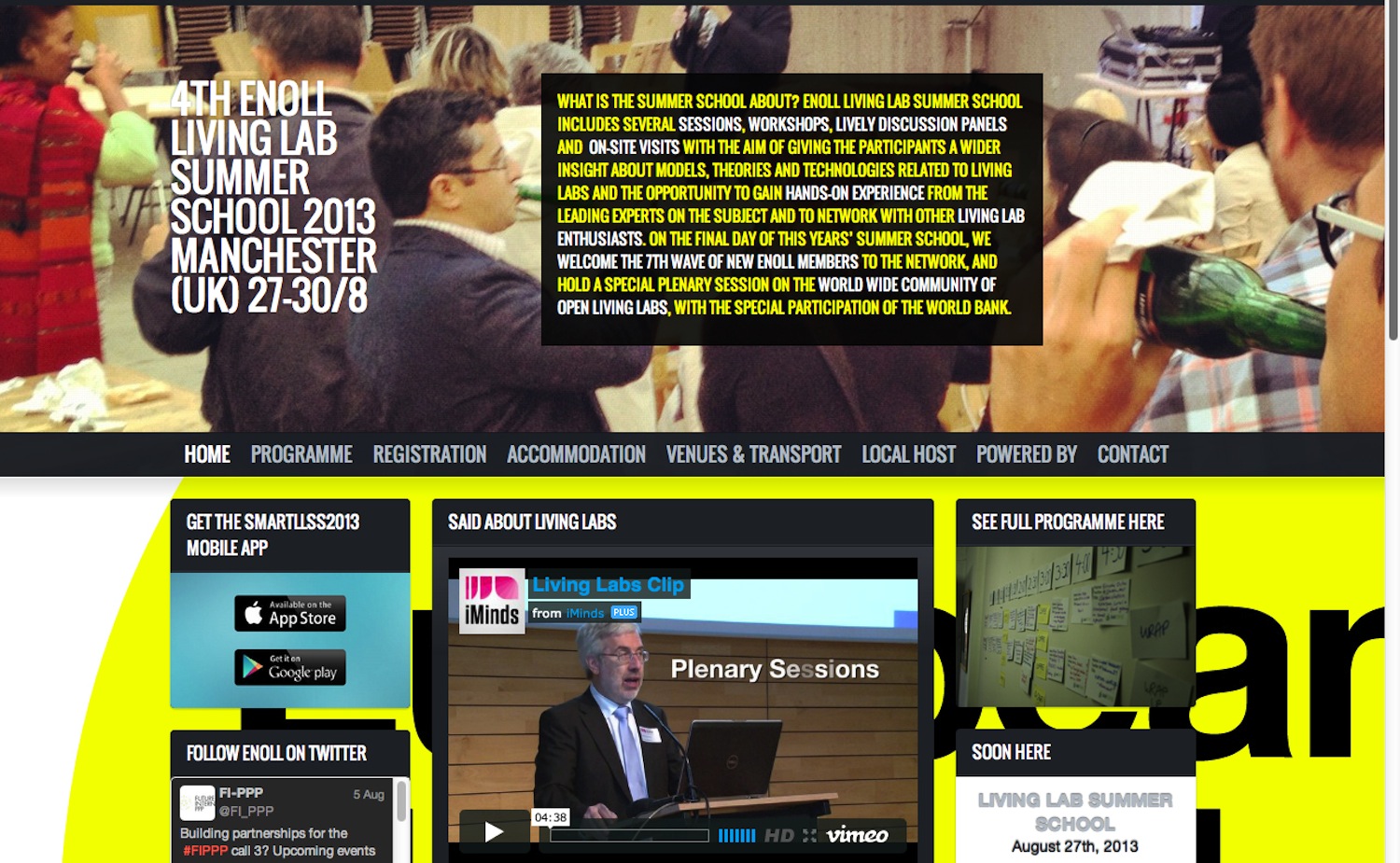
I spent all of last week in the 4th ENoLL Summer School, in the great city of Manchester. Summer school keeps getting better; we had a fabulous time in Helsinki last year, but this year’s event was even more intense and stimulating.

There were too many highlights to be listed here. Some of the key moments, news and touching moments were…

…the research day. The scientific community around Living Labs is growing and showing results.

… the World Bank collaboration meeting. Our Memorandum of Understanding is turning into concrete action plan and joint activities.

…and finally, farewell to Anna Kivilehto, our fantastic network manager. She goes forward in her career as she was headhunted for Laurea Living Labs network. Loss for ENoLL, great news for Laurea. Congratulations Anna, the great news is that you move to Helsinki and I’ll see you more often!

Summer school made a wave; “ENoLL(#ENoLLSS13) has reached more than 77,600 accounts with around 700,000 impressions on Twitter. 111 contributors have been posting more than 420 tweets within 7 days short period.”

See you there:ENoLL Summer School !!!

ENOLL

The travel calendar for the fall starts to fill up. It’s gonna be a fantastic autumn. The first goal is Manchester, where the user driven innovation people gather together for the 4th European Network Of Living Labs Summer School. The previous three events in Paris, Barcelona and Helsinki have been great, and we can expect the same for Manchesher. One difference between the previous editions and this one is the location, which is in the middle of the (beautiful) city.

The summer school kicks off with a research day, and continues through the whole week. It will be also the launch event for the World Bank & ENoLL collaboration – community-driven Living Labs are especially valid way to do innovation int he developing countries and cities.

More info can be found in the summer school websiteSee you there!!!

City Boy Goes Rural

…Well not really – I am born in Joensuu, which is hardly a city, and raised in Juva, which is even less so. So I am just the right person to join the Smart Rural World Congress in Penela, Portugal, next week. The event is organised by Smart Rural Living Lab, and I will discuss the possibilities and challenges of smart solutions for scarcely populated regions (we are experts in that, as basically the whole of Finland counts as such).

Familiar buzzwords there… Participatory Design, Open Innovation and Design Thinking. Let’s see if they really do as they preach; one of the recognised problems of the Living Labs scene is that despite saying that the activities are user-driven, they are actually producer-driven; the companies rarely are willing to challenge their concepts beyond basic user-testing. The ones who actually do go all the way can get remarkable results, like the famous Lego case.

Anyway, while in Penela, maybe I could do some mountain biking as well. But maybe not as hc as the guys going downhill in the video…